

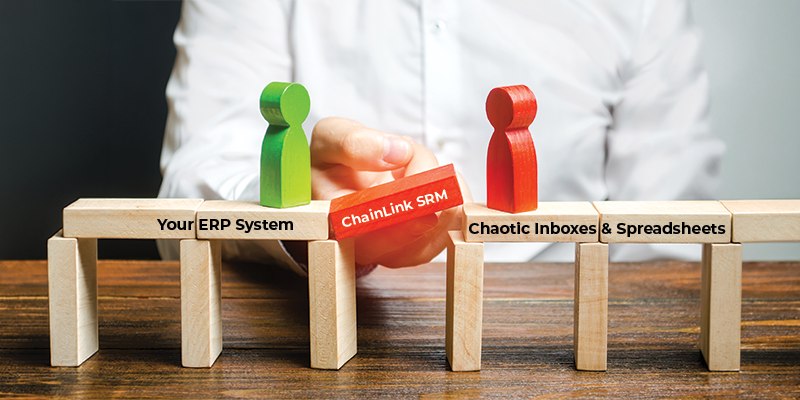
The short version: ChainLink SRM's Open Order Management module is purchase order management software built for the part of the job that begins after the PO is issued — open order execution. It works alongside your ERP rather than against it, extending the system of record into an execution layer with ERP purchase order integration, supplier follow-up automation, one standardized workflow, and real-time exception visibility. What follows is why most procurement teams lose the thread once the PO goes out, and how a system of action picks it back up.
Here's a quiet truth about procurement: almost no one actually has a purchase order problem. Your ERP can cut a PO in seconds — approvals routed, numbers assigned, terms attached, and the document sails off to the supplier looking thoroughly official. The hard part begins the instant after, in the long, foggy stretch between "PO issued" and "goods on the dock." That's where schedules quietly slip, promises change, and a single buyer's inbox becomes the de facto record for a multimillion-dollar supply base. And that gap is anything but cheap: McKinsey pegs supply chain disruptions of a month or more at once every 3.7 years for the average company — enough to erase close to half a year's profits over a decade. Closing that gap is precisely what purchase order management software should do, and precisely what ChainLink SRM was built for.
Want the wider view first? Our guide to purchase order management software that goes beyond the issued PO maps what these tools should do, where most fall short, and how to size them up. This piece zooms all the way in on the execution stage.
Your open POs are sitting right there in the ERP, neatly numbered and dated. The catch is what a PO actually is: a promise on paper. It captures what you asked for — not whether the supplier accepted it, started it, or is quietly running two weeks behind. The record freezes at the moment of issuance while the real world keeps moving, and that space between the record and reality is where late parts are born. So the question that matters isn't "do we have the order?" It's"do we know what's happening to it right now?" For most teams, the answer is no.
You know the weekly ritual. A buyer pulls the open order report, sorts it by due date, and hunts for the lines most likely to bite. Then come the emails — dozens of them — asking suppliers to confirm dates, acknowledge changes, or explain how a promised ship date drifted two weeks to the right. Replies trickle back into individual inboxes. Commitments get copied into a spreadsheet. The spreadsheet gets reconciled against the ERP. A few days later, the whole thing starts over.
And that's the rub: email feels like communication, but it isn't control. The information scatters, the responses arrive in a hundred different formats, and the only person who truly knows where an order stands is the buyer carrying it, right up until that buyer takes a week off. So the real shortage was never purchase orders. It's supplier execution visibility: a shared, reliable, real-time read on whether what you ordered will actually arrive when you need it. That's the visibility procurement execution software is supposed to deliver.
(For the deeper diagnosis, here's why purchase order management software still fails at open order tracking.)
So where should that missing visibility actually live? Not inside the ERP. Your ERP is the system of record — item masters, purchase order data, financials, the entire transactional backbone — and that's exactly what it's brilliant at, and exactly where it should stay. The gap was never in the record. It's in everything that has to happen around the record once the PO leaves the building.
That "everything" has a name: open order execution — the hands-on management of purchase orders after they're issued, from supplier confirmation and follow-up through exception handling and delivery assurance, right up to the moment goods are received. It's messy, human, and relentlessly back-and-forth — which is to say, nothing an ERP was designed for. Systems of record; this work needs a system of action, and that's the layer ChainLink SRM occupies. Through ERP purchase order integration, it takes the open PO data your ERP already holds and turns it into something a procurement team can actually work with: prioritized, monitored, chased, and escalated when needed.
In practice, ChainLink SRM sits shoulder to shoulder with the ERP as the execution and supplier collaboration layer. The ERP keeps the official record; ChainLink SRM keeps the orders moving — pulling open PO data forward, organizing the supplier conversation around it, and feeding clean, confirmed status back so the record stays honest. Think of it as supplier collaboration software aimed squarely at open order execution: static data becomes a living workflow.
That's the philosophy. Here's the practice. The Open Orders module is the heart of the platform, and it quietly handles the five things every buyer wishes they had time to do consistently — automatically.
Every open order, every supplier, every due date — gathered in one place the whole team can see, instead of locked inside one person's inbox. When a manager asks where the parts for the March build stand, the answer is on a screen, not in a buyer's memory.
No buyer should spend a week re-sending the same status request to the same supplier. ChainLink's supplier follow-up automation runs the routine chase — confirmations, acknowledgments, reminders — so a human only steps in when something genuinely calls for one.
Instead of free-text replies, someone has to re-key; suppliers respond in a structured format. Confirmed dates, quantity changes, and acknowledgments come back as clean data the system can act on — not prose you're decoding at 7 p.m.
ChainLink SRM surfaces the orders that actually need attention: late lines, unconfirmed orders, shifted dates, quantity mismatches, past-due commitments, and the suppliers who've gone conspicuously quiet. Here, silence is treated as a signal — not the absence of one.
Leaders get a live read on exposure across the open order book — by program, supplier, and commodity — without convening a meeting to assemble it. Risk becomes something you see coming, not something you explain afterward.
All that automation only pays off if everyone's running the same play. Plenty of tools boast about endless configuration; we'd call that a trap. When every buyer, team, and plant can bend the process to its own habits, you don't get flexibility — you get fragmentation: a dozen private versions of "how we follow up," none of them visible to a manager, all of them walking out the door the day a buyer does. ChainLink SRM takes the opposite stance, running a single standardized open-order workflow across the business unit so every team chases orders the same way.
Standardized doesn't mean blunt. The workflow already treats orders differently by supplier, buyer, program, commodity, due date, and risk profile — a strategic supplier on a critical program earns earlier, more frequent outreach, while a dependable vendor on a low-risk commodity gets a gentle nudge as the date nears. The difference is that the logic is set once, for everyone, rather than reinvented buyer by buyer. And the payoff is the one thing standardization always delivers: cleaner data, faster onboarding, audit-ready consistency, genuine cross-team visibility, and a process that no longer hinges on who remembered to follow up this week.
Running one consistent workflow has a happy side effect. The warning signs finally stand out. Plenty of vendors will sell you an AI crystal ball; we'd rather offer something more grounded — predictive intelligence built on the signals your own orders are already throwing off. No magic, no theatrics — just steady attention to the patterns that reliably precede a late delivery. ChainLink SRM watches for the early warnings that experienced buyers learn to dread:
Any one of these is easy to miss on its own. Watched continuously across the whole order book, together they give your team room to act while there's still time to act. That's the kind of prediction that earns its keep.
By now, the contrast nearly writes itself, but let's make it explicit. Search "purchase order management software" and you'll meet a crowded field. Most of those tools handle the front of the process — requisitions, approvals, issuing POs, matching invoices, paying suppliers — and then take a bow. ChainLink SRM covers that front end too, and not as a me-too checkbox: our procure-to-pay module builds predictive insight into the buying decision itself, so the calls made before a PO ever goes out are sharper than what generic P2P tools manage. Where ChainLink SRM truly separates, though, is everything after. For most tools, the front end is the whole show — once the PO ships, they fall silent. ChainLink's Open Orders module picks up exactly where they leave off, running the execution stage after the PO. Here’s the difference.
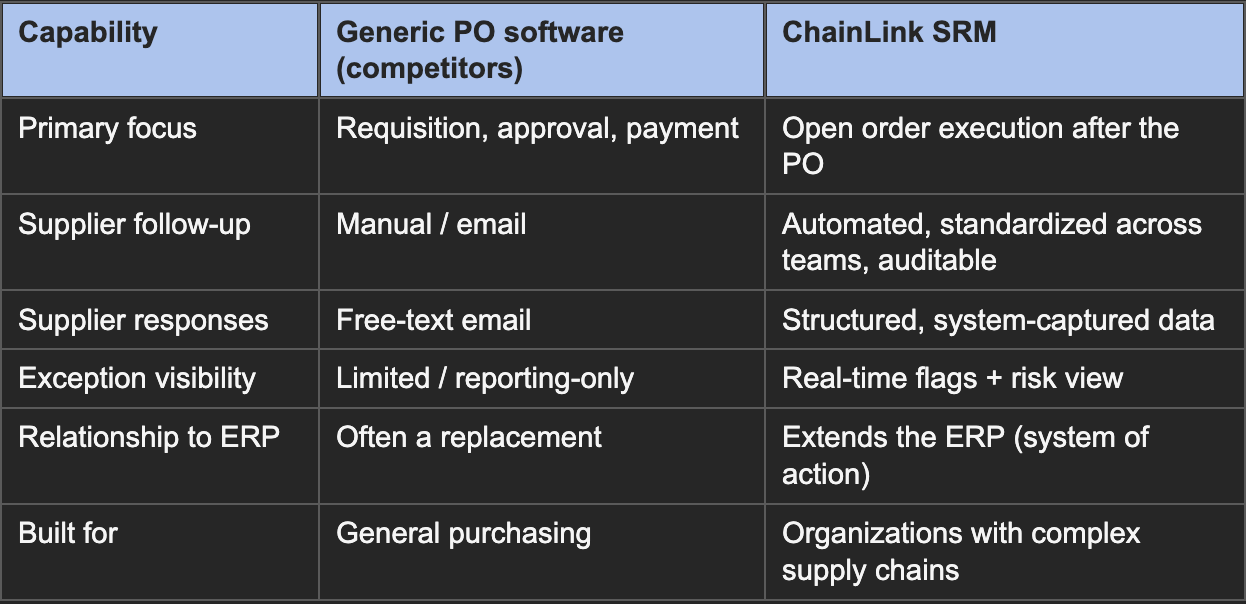
In short, the Open Order Management module is built around supplier execution rather than requisition and payment. Its focus is open order control — the post-PO operations window that most tools treat as an afterthought — and it's designed for complex procurement environments that involve high part counts, long lead times, and suppliers that must be actively managed. That makes it a natural fit for organizations with complex supply chains, where a single late line can stall an entire build and supplier follow-up is a full-contact sport.
Open orders stop being a scatter of risk across inboxes and spreadsheets and become a managed execution process. Visibility is shared. Follow-up is automatic. Responses are structured. Exceptions surface early. And managers see risk while it's still a forecast, not a postmortem.
Your ERP will continue doing what it does best — serving as the system of record. ChainLink SRM takes it from there. So, if your team is spending its weeks chasing suppliers instead of managing them, it may be time to put a system of action behind your system of record.
Every late part began life as an open order that no one was watching closely enough. You can keep finding out on the production floor — the stalled build, the expedite fees, the call to your customer you'd rather not make — or you can see it coming while there's still time to act. That's the whole promise of open order execution: nothing important left to chance, nothing critical left in an inbox.
Stop chasing your suppliers. Start commanding your open orders. Request a demo of the ChainLink Open Orders module — and never be blindsided by a promise-date change again.
David is the Chief Operations Officer and Director of Business Development at TTP Solutions LLC. Since 2019, David has been the driving force behind sales, marketing, and organizational development. David holds a B.B.A. in Entrepreneurship and a B.A. in Spanish from Middle Tennessee State University. He has a passion for helping others to solve problems creatively. Husband to KerrieAnn, David loves photography, hiking, traveling, and reading.