


ERP and conventional SRM tools track the manufacturer’s own transactions, so visibility naturally stops at the purchase order boundary — the system simply has no record of what a Tier 1 supplier ordered from a Tier 2 supplier, or what that Tier 2 supplier depends on. Mapping the extended supplier network helps identify who’s connected to whom, but a map alone doesn’t tell you which active order is exposed right now. Real multi-tier PO traceability requires three things working together: a dependable link between related commitments across tiers, permissioned participation so each party sees only what’s relevant to its role, and exception signals that travel upward before the Tier 1 delivery date actually slips. Buyers evaluating a platform should look past the dashboard and ask whether it connects a sub-tier event to a specific order, part, and date — and whether that connection leads to a workflow or just a prettier report.
A buyer checks a Tier 1 supplier’s status on an open purchase order. The supplier acknowledged it. The promised delivery date hasn’t moved. By every measure the buyer’s system tracks, the order is healthy.
One tier down, a Tier 2 component order is already late. The Tier 2 supplier is waiting on a specialized material from a Tier 3 source that hasn’t shipped. The Tier 1 supplier still believes it can recover the schedule, so it hasn’t said anything yet. The buyer’s ERP shows no exception, because there is nothing in the ERP to flag. The problem doesn’t become visible until the recovery window has mostly closed and the original PO is genuinely at risk.
This is an illustrative scenario, not a documented case — but it’s a familiar one to anyone who has managed purchase orders in a multi-tier supply chain. And it points to the real question behind how to improve supply chain visibility for orders like this one: the manufacturer’s system didn’t miss an alert. The lower-tier commitment was never inside the system to begin with.
Part 1 ("The 42% Problem: Why Most Manufacturers Can't See Past Their Tier 1 Suppliers") covered why a tier-1 supplier can look completely healthy while a disruption is already developing farther upstream. This article picks up where that leaves off: what it actually takes to trace an open PO three tiers deep, without turning your supply base into an all-access data dump.
Your ERP isn’t being difficult. It’s answering the question it was built to answer: did we issue this PO, did the supplier acknowledge it, and has the promised date changed? That’s a transactional question.
What an ERP generally can’t tell you is what happens on the other side of that transaction. A Tier 1 supplier issuing its own order to a Tier 2 supplier is a separate transaction, in a separate system, that your ERP has no reason to know about. Multiply that by however many tiers sit between your PO and the raw material or specialized process it ultimately depends on, and the visibility gap isn’t a bug — it’s the edge of the system’s transactional boundary.
More emails, more check-in calls, and more supplier reminders will not fix this, because the problem isn’t a lack of talking — it’s a lack of structure connecting what gets said to the order it affects.
Sphera’s survey of 250 chief procurement and supply chain officers found that 70% of organizations report difficulties with data accuracy and quality from Tier 2 through Tier 4 suppliers, and that 26% still rely on manual risk assessments below Tier 1 rather than a structured, ongoing process. That’s not a communication failure. It’s an information-architecture failure — the data either isn’t collected consistently, isn’t verified, or isn’t connected to anything a buyer can act on.
Adding another supplier portal is not progress if everyone just exports it into another spreadsheet. The fix isn’t more contact points between people. It’s a structured way to connect what a sub-tier supplier says to the specific order it’ssupposed to support.
Supplier mapping and multi-tier PO traceability get used interchangeably, and that’s a problem, because they answer different questions.
Mapping identifies companies and relationships: who supplies whom, where they’re located, and where concentration risk might exist. That’s genuinely useful for strategic sourcing and risk assessment. What it doesn’t do, on its own, is tell you which of your active purchase orders is currently exposed to a specific sub-tier event. A supplier map is useful. Unfortunately, maps don’t tell you which shipment is currently on fire.
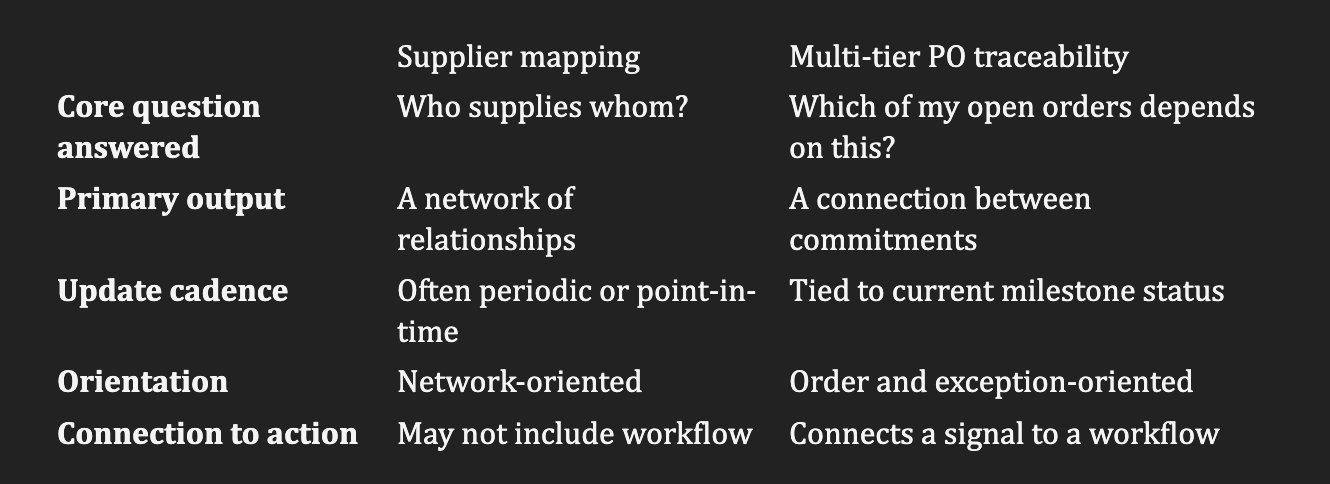
Both have a place. But if the goal is knowing whether this PO, for this program, is at risk right now, a static map isn’t built to answer that. Traceability is.
Trying to trace an open PO three tiers deep by simply collecting a longer supplier list doesn’t work — length isn’t the missing ingredient. A few specific capabilities are.
A dependable connection between related commitments. Don’t assume order numbers align across companies, or that every supplier runs the same ERP, or that every relationship can be matched automatically. They won’t, and it can’t. What matters is a reliable way to associate the manufacturer’s PO with the relevant downstream commitment supporting it, even when the identifiers on each side don’t match.
Drill-down that answers operational questions. Moving from an original PO into its lower-tier dependencies should tell a buyer something useful — which milestone slipped, which supplier is involved, what’s at risk — not just display a supplier family tree.
Order-level context. A sub-tier signal becomes far more useful once it’s tied to a specific order, PO line, part, required date, program, plant, or customer commitment. An isolated risk alert with no order attached is trivia. The same alert connected to a program with a hard customer date is a decision.
Visible data ownership. Every piece of information should carry a source and a timestamp: who provided it, when it was last confirmed, whether it’s supplier-confirmed, imported, or inferred, and who owns the next update. Without that, conflicting or missing information just becomes another argument instead of a resolvable gap.
Workflow behind the view. An operational dashboard should sit in front of an actionable workflow, not stand in for one. Seeing a problem and being able to assign it, track it, and resolve it are different things.
Integration that respects the ERP. Multi-tier traceability should complement your ERP and existing systems, not require you to rebuild your transaction environment to get it. It should preserve existing order and part identifiers rather than creating a second, parallel version of the truth.
Accountability leadership can actually use. Leaders should be able to see which exceptions are unresolved, which orders they threaten, who owns the next action, and how long the issue has been open — without asking someone to build that view by hand.
A normal alert tends to stay where it started. A cascading exception is different: a problem detected at Tier 2 or Tier 3 should be able to reach the appropriate person at Tier 1 — or at the manufacturer — before the Tier 1 delivery date is actually late, not after.
To be clear about what that does and doesn’t mean: this is about the exception flag becoming visible to the right participant and connecting to a workflow, not about a system autonomously resolving the problem. Someone still has to decide whether to expedite, re-source, or adjust a schedule. What cascading exceptions change is when that person finds out, and whether they find out with enough order-level context to make a good call.
It also doesn’t mean every participant sees the entire network. A Tier 3 processor’s problem should reach the Tier 1 supplier and the buyer who owns the affected order — not every buyer at the company, and not every other supplier in the network. Cascading upward is about reaching the right person, not everyone.
Here’s where a lot of well-intentioned multi-tier visibility programs stall out: they ask suppliers for more than suppliers are willing, or able, to give.
A Tier 2 or Tier 3 supplier has real reasons to be cautious about a platform that expects it to expose its entire customer list, its commercial terms, or sourcing relationships that have nothing to do with your order. Some of that hesitation is commercial confidentiality. Some of it is that their own upstream visibility is just as thin as yours. Either way, treating reluctance as bad faith gets you nowhere. Tiered permissions — where each participant sees only what’s relevant to its role and the specific order in question — are what make participation possible without demanding total transparency.
Participation also has to be genuinely low-friction, or it won’t happen at scale. If contributing a status update takes longer than the problem it’s solving, suppliers will do what they’ve always done: answer inconsistently, or not at all. The bar isn’t a sophisticated integration for every supplier tier — it’s a request that’s clear, an update that’s fast, and access that’s limited to what that supplier actually needs to see.
“Real-time” gets used loosely enough that it’s worth defining plainly: useful real-time visibility means relevant information reaches the right people and workflows early enough to change the outcome. It does not mean every supplier streaming every data point continuously — that’s neither realistic nor necessary.
Gartner puts the underlying gap in stark terms: 95% of supply chains must react quickly to change, but only 7% can execute decisions in real time. Speed of decision-making, in other words, is a rarer capability than speed of information. A weekly status update can be technically recent and still be operationally useless, if the buyer needed to act three days earlier to have any good options left. The point isn’t to chase a faster refresh rate for its own sake. It’s to close the gap between when a problem is knowable and when the person who can act on it actually finds out.
No single tool does this alone. Meaningful supply chain visibility usually comes from a combination: the ERP as the system of record, SRM for supplier relationships, supplier portals for direct data exchange, mapping tools for network structure, integration platforms and APIs to move data between systems, event and milestone tracking, analytics, workflow management, and increasingly, control-tower style views that try to bring several of these together.
None of that technology improves visibility by existing. It improves visibility when it connects information to something specific — an order, a date, a part, a supplier, a decision, an owner, a workflow. A dashboard that displays disconnected data points from five systems is not more visible than five separate spreadsheets; it’s just better looking. The test for any of these technologies, including permissioned multi-tier collaboration tools, is whether they shorten the distance between a sub-tier event and the person who needs to act on it.
A few patterns are worth treating as yellow flags during an evaluation:
None of these are disqualifying on their own, but more than one or two together is a sign the platform is built for supplier mapping, not order-level traceability.
Recognizing that visibility needs to extend below Tier 1 — and knowing what to look for when it does — still leaves an open question: how do you actually evaluate whether a specific platform turns that visibility into something your team can act on?
Part 3 will walk through exactly that. In the meantime, learn more about ChainLink SRM’s approach to Open Order Management.
David is the Chief Operations Officer and Director of Business Development at TTP Solutions LLC. Since 2019, David has been the driving force behind sales, marketing, and organizational development. David holds a B.B.A. in Entrepreneurship and a B.A. in Spanish from Middle Tennessee State University. He has a passion for helping others to solve problems creatively. Husband to KerrieAnn, David loves photography, hiking, traveling, and reading.