


Most manufacturers can see their direct, Tier 1 suppliers clearly. Far fewer can see what those suppliers depend on. Industry reporting attributed to McKinsey research suggests roughly 95% of companies have solid Tier 1 visibility, while only about 42% can see beyond it — even though a large share of risk incidents originate at Tier 2 through Tier 4. That gap matters because a healthy-looking Tier 1 scorecard can sit directly on top of a sub-tier failure that’s about to slip an open purchase order’s delivery date. The practical shift manufacturers should start making: ask not just who your suppliers are, but which active orders, parts, and programs are exposed when a supplier’s supplier runs into trouble.
In April 2025, China introduced new export restrictions on rare earth elements and rare-earth magnets — materials used in everything from EV motors to power steering systems. Within weeks, several European automotive supplier production lines and plants had shut down, according to Reuters and Europe’s automotive supplier association, CLEPA. By early June, CLEPA reported that “these restrictions have led to the shutdown of several production lines and plants across Europe, with further impacts expected in the coming weeks as inventories deplete.” Suzuki, for its part, halted production of its Swift model (excluding the Swift Sport variant) from late May 2025 because of the same rare-earth shortage.
None of the automakers or Tier 1 suppliers affected by this had done anything wrong. Their direct contracts were intact. Their Tier 1 relationships were, by most conventional measures, healthy. The failure that reached them originated multiple tiers upstream, in rare-earth refining and magnet production most manufacturers had never mapped. It’s worth imagining, purely as an illustration, what a typical Tier 1 scorecard would show a buyer in the days before a shutdown like this reaches their line: on-time delivery within range, quality holds passed, no open exceptions. Nothing in that scorecard would tell you a refiner four tiers away had just lost its export license. That’s not a documented fact about any specific company in this case study — it’s the structural reason this kind of disruption is so hard to see coming.
Supply chain visibility is the ability to see, verify, and act on information about the suppliers your business depends on — not just whether they exist, but what they’re doing, what condition they’re in, and what they in turn depend on. Asking what supply chain visibility is is really asking how far down that chain of dependency your organization can actually see, and how current that view is.
Visibility is often confused with reporting. A dashboard that shows your Tier 1 suppliers’ on-time delivery rates is reporting. It only becomes visibility when it provides an opportunity to intervene- namely, a structured, current, and traceable view of dependencies that lets you act before a problem reaches your production line, not after.
Tier 1 visibility exists because it’s contractually enforceable. You hold a direct agreement with your Tier 1 supplier. You have audit rights, negotiating leverage, and a documented relationship. None of that applies automatically to Tier 2, Tier 3, or deeper sub-tier suppliers — the companies your direct supplier depends on for raw materials, components, or specialized processing.
Tier 1 suppliers frequently treat their own supplier networks as proprietary information, and many have only partial visibility into their own upstream exposure. The result is a hard boundary: procurement systems, ERP records, and most supplier scorecards are built around the purchase order, and a purchase order only exists between you and your direct supplier. Below that line, the data simply isn’t structured to exist inside your systems.
Here is where the gap becomes measurable. JAGGAER reports that 95% of companies have Tier 1 visibility, while only 42% can see beyond it, attributing the figures to McKinsey’s 2025 supply chain risk research. We reviewed McKinsey’s underlying published analysis directly; it confirms the broader finding — that “the majority of companies understand their supply chain risks only up to tier one,” and that tier-two risk awareness has declined for two consecutive years — but we could not independently locate the specific 95%/42% figures as rendered text in that source. We’re presenting the numbers as JAGGAER’s reporting, not as a directly confirmed McKinsey statistic.
What is independently confirmed, from Sphera’s own research, is where the risk actually concentrates. In a survey of 250 chief procurement and supply chain officers, Sphera found that 85% of risk and critical incidents occur in Tier 2 through Tier 4 suppliers — the exact layer where visibility is thinnest.

The visibility and the risk sit on opposite ends of the same supply chain
Sub-tier concentration is often invisible until a geopolitical event exposes it. The World Economic Forum, citing McKinsey research, reports that supply chain disruptions lasting longer than a month occur every 3.7 years on average, and that they can cost a company up to 45% of one year’s profit over the course of a decade — not 45% of a decade’s cumulative earnings, but up to nearly half a year’s profit repeated across that ten-year window.
Rare earths are a clear example of concentrated dependency hiding in plain sight. The European Central Bank found that more than 80% of large European firms sit no more than three intermediaries away from a Chinese rare-earth producer — a network exposure that had been building for decades before the April 2025 export restrictions made it visible. That finding is specific to large European firms; it isn’t a claim about manufacturers generally or about companies outside Europe.
This is the mechanism most visibility conversations skip. An open purchase order isn’t just a line item — it’s a chain of dependent commitments. Your PO represents a promise from your Tier 1 supplier. That supplier’s ability to keep the promise depends on a Tier 2 supplier delivering a component on time. That Tier 2 supplier, in turn, depends on a Tier 3 material or process — a casting, a plating step, a refined material — that it doesn’t control either.
When a disruption hits at Tier 3 or Tier 4, it doesn’t announce itself to you. It propagates upward, tier by tier, consuming buffer inventory and schedule slack at each step before it finally reaches your Tier 1 supplier as a missed or revised promise date. By the time your ERP shows a delivery slip, the disruption may have been moving through the chain for weeks. The open order was exposed the entire time — you simply had no way to see it.
This is why dashboards alone don’t create visibility: a report that only reflects your Tier 1 supplier’s current status is reporting on the last visible link in a chain, not the chain itself.
These terms get used interchangeably, but they answer different questions. Visibility is the ability to see what’shappening in your supply chain — statuses, confirmations, exceptions — as it happens or close to it. Transparency is the willingness and structure to share that information openly across organizational boundaries, including boundaries where no direct contract exists.
You can have visibility into your own Tier 1 data without transparency from your suppliers about their own upstream dependencies. Multi-tier programs typically fail not because visibility technology doesn’t exist, but becausetransparency — the sharing of sub-tier information across companies that have no contractual obligation to share it — doesn’t happen by default. Closing that gap requires structure, not just goodwill.
Multi-tier visibility isn’t one capability — it’s a stack. Each layer answers a different question, and most organizations only have the first one or two built out.
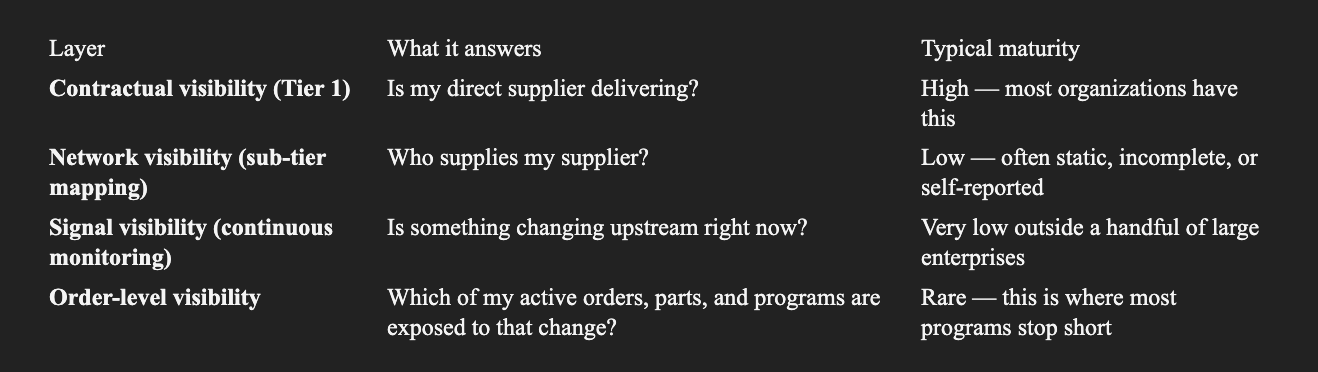
The first layer is necessary but not sufficient. The fourth layer is the one that actually changes what a buyer or planner does on a Tuesday morning.
A static sub-tier map — a one-time exercise to document who supplies whom — is a reasonable starting point, but it degrades the moment it’s finished. Supplier relationships shift, qualifications change, and geopolitical exposure movesfaster than most mapping projects get refreshed. A map also doesn’t, on its own, tell you which of your open commitments are riding on any given node in that network.
Meaningful multi-tier visibility has to connect a sub-tier event to something concrete: an active purchase order, a program, a part number, a committed date, a customer commitment downstream. Without that connection, a supplier map is an interesting document. With it, it becomes a way to know — in something closer to real time — what’s actually atrisk.
What Multi-Tier Open-Order Visibility Must Reveal
For visibility to extend meaningfully below Tier 1, it needs to surface a few specific things: which open orders and programs sit downstream of a given sub-tier supplier or material; how a flagged exception at Tier 3 or Tier 4 should cascade upward to the buyer who owns the affected Tier 1 relationship; and which stakeholders — including lower-tier participants themselves — need to see which piece of that picture, since not every party should see everything. For more on this topic see: managing the commitment after a purchase order is issued
This is a workflow problem as much as a data problem. Multi-tier order tracing, drill-down visibility into specific POs and programs, exception flags that cascade upward instead of dead-ending at the tier where they’re first detected, and tiered data permissions that give each participant only the information relevant to them are the practical building blocks. None of that requires — or claims — that a system resolves problems autonomously; it means the right person sees the right signal early enough to act on it.
Recognizing that visibility needs to extend below Tier 1 is the easier part. The harder part is doing it without creating a data-governance mess, without asking suppliers to disclose information they have no incentive to share, and without burying buyers in noise from tiers they can’t act on directly.
Part 2 will examines what it actually takes to trace an open order across multiple supplier tiers, preserve relevant permissions, and allow exception signals to move upward before a downstream commitment fails. Read it here
Tier 1 visibility isn’t wrong — it’s just incomplete, and the incompleteness is measurable, well-documented, and directly connected to the open orders sitting in your ERP right now. The organizations that get ahead of this aren’t the ones with the most complete supplier maps; they’re the ones that can connect a sub-tier signal to a specific order before the delivery date slips.
Learn more about how ChainLink SRM approaches Open Order Management.
David is the Chief Operations Officer and Director of Business Development at TTP Solutions LLC. Since 2019, David has been the driving force behind sales, marketing, and organizational development. David holds a B.B.A. in Entrepreneurship and a B.A. in Spanish from Middle Tennessee State University. He has a passion for helping others to solve problems creatively. Husband to KerrieAnn, David loves photography, hiking, traveling, and reading.