


The demo usually looks great. A polished global map. A few colorful dashboards. A red indicator showing that one order is at risk. Someone says “real-time, end-to-end visibility” at least twice.
Then the buyer asks a few plain questions. Which lower-tier commitment caused this? Which Tier 2 or Tier 3 supplier is actually involved? Which PO line is exposed? When did this start? Who can see this information, and who can’t? What happens next, and who owns it?
The demo gets vague. This is an illustrative pattern, not a specific vendor call — but it’s a common one, because a red dot is not a root cause, and a map is not purchase order traceability.
If you’re evaluating supply chain visibility software for the specific problem this series has covered — tracing an open order below your direct supplier — the good news is that the evaluation doesn’t require a data science background. It requires four demo tests, a scorecard, and a willingness to say “show me” instead of “tell me.”
"What multi-tier PO traceability actually requires" covered the structural and technical requirements for real traceability. This article covers how to test whether a given platform actually meets them.
A serious evaluation of supply chain visibility software should test whether the platform can follow an order below Tier 1, connect a lower-tier exception to the original PO, cascade the right flags to the right people, protect commercially sensitive information along the way, drill down to root cause instead of stopping at a status indicator, and move directly from visibility into a structured workflow. It should also support a financial case finance can actually audit — one that separates working capital effects from recurring savings rather than blending them into a single inflated number. Everything below is built around four core demo tests, a printable scorecard, and a CFO-ready ROI worksheet — and a direct look at where today’s leading open-order platforms, including ChainLink SRM, actually stand against that bar.
“Supply chain visibility software” gets applied to a wide range of tools that solve related but different problems. Shipment-tracking platforms show where freight physically is. Supplier risk-scoring tools assess financial and compliance exposure. Network-mapping tools document who supplies whom. Control-tower platforms try to aggregate several of these into one view.
Open order execution — the specific problem this series has focused on — is a different capability again: tracing an active purchase order through the commitments that support it, below your direct supplier, and connecting a disruption to the exact order it threatens. A platform can be genuinely good at shipment tracking or supplier scoring and still not do this. That’s not a knock on those tools. It’s a reason to be precise about which problem you’re solving before you sit through a demo.
It’s also worth being precise about where the established players actually sit today, because this market breaks into three distinct groups, and buyers often shop across all three without realizing they’re comparing different things.
The first group is Tier 1 open-order point solutions. These are mature, well-built platforms for exactly what they’redesigned to do — give buyers a live dashboard, automate supplier follow-up, and escalate exceptions on the purchase orders they issue directly to their Tier 1 suppliers. The strong ones in this category are genuinely good at that job. What none of them do, is capture, structure, or store what’s happening at Tier 2 or Tier 3 — because that isn’t the problem they set out to solve. A related set of tools market “multi-tier” supplier engagement, but their actual job is should-cost modeling and strategic sourcing analytics for large enterprises — a different question (what should this cost, and who’s really in the chain) than the one this checklist is built around (is this specific PO late, and who owns the next action).
The second group is enterprise source-to-pay suites. Each includes a procure-to-pay or PO module, but it’s one piece of a much larger sourcing, contracting, and invoicing transformation, priced and scoped for large enterprises undertaking that broader project. None of them add distinct multi-tier PO-execution capability beyond what a risk-mapping add-on provides separately, and buying one means signing up for a full procurement overhaul, not a targeted fix for open-order visibility.
The third group is dedicated multi-tier risk and mapping platforms. These genuinely do go several tiers deep, and some are excellent at it. But they’re built for risk, compliance, and resilience teams, not for the buyer managing today’s open orders — none of them tie a sub-tier signal to a specific, live PO a buyer is actively working. Nobody in any of these three groups, as this market exists today, ties sub-tier data to live PO execution in one workflow.
Managing what happens after a PO is issued is its own discipline. If you haven’t already, it’s worth reviewing what purchase order management software should do after approval before evaluating anything that claims to extend that visibility below Tier 1 — the same gaps that show up at the direct-supplier level tend to compound at every tier below it.
Do not buy the slide. Test the workflow.
Before the demo, pull a small, representative sample of your own PO data: one healthy open order, one that’s unacknowledged, one that’s already late, one with a changed promise date, one tied to a critical part or program, one with a known sub-tier dependency if you have that information, and one supplier with limited digital maturity. You are not running a full implementation. You’re testing whether the platform can represent your actual operating reality instead of a curated example.
Then ask the vendor to show you, using that data, how it enters the system, how order relationships are established, how exceptions get flagged, what suppliers at each tier actually see, what buyers see, what managers see, what action starts automatically versus manually, and which capability is live today versus on a roadmap.
Ask the vendor to start with one real or representative PO line and show the Tier 1 commitment, the connected Tier 2 commitment behind it, and the relevant Tier 3 dependency, if one exists in the data. A credible answer shows the relationship between those commitments and the specific part, quantity, date, or program they support — including how the platform reconciles different order numbers or systems across companies that don’t share an ERP.
A supplier network map by itself does not pass this test. Knowing who’s connected to whom is not the same as knowing which of your open orders depends on that connection right now.
Demo prompt: “Start with this PO line. Show me the downstream commitment that supports it, then follow that commitment as far upstream as your platform can verify.”
Ask the vendor to simulate a lower-tier event — a late material, a missed milestone, a quantity shortfall, a non-response, a changed promise date, a quality hold, a capacity constraint — and show exactly where it originates, which Tier 2 and Tier 1 commitments it touches, which original PO line becomes exposed, who receives the signal, what each of those people actually sees, and what workflow begins.
Where the data and timing allow it, that exception should reach the right person before the Tier 1 delivery is already late. Early visibility doesn’t guarantee a recovery — it just means someone finds out while there’s still a decision to make instead of a miss to explain.
Demo prompt: “Create a Tier 3 milestone exception. Show me exactly how it reaches the buyer responsible for the original PO, and what happens next.”
A Tier 3 supplier has no reason to see your margins, your internal cost data, another supplier’s commercial terms, or program information unrelated to its own scope. Ask the vendor to show — not describe — the actual view for the manufacturer, the Tier 1 supplier, the Tier 2 supplier, and the Tier 3 supplier, side by side.
A platform should let a buyer move from portfolio, to program, to plant, to supplier, to order, to PO line, to the lower-tier dependency behind it, to root cause, to the next action. A tool that shows “late” without showing why, where, or what else is affected gives you awareness without control.
Also ask whether it can tell the difference between supplier-confirmed information, data imported from your ERP, inferred risk, and information that’s simply outdated or in conflict with another source. Treating all of that as equally trustworthy is its own kind of red flag.
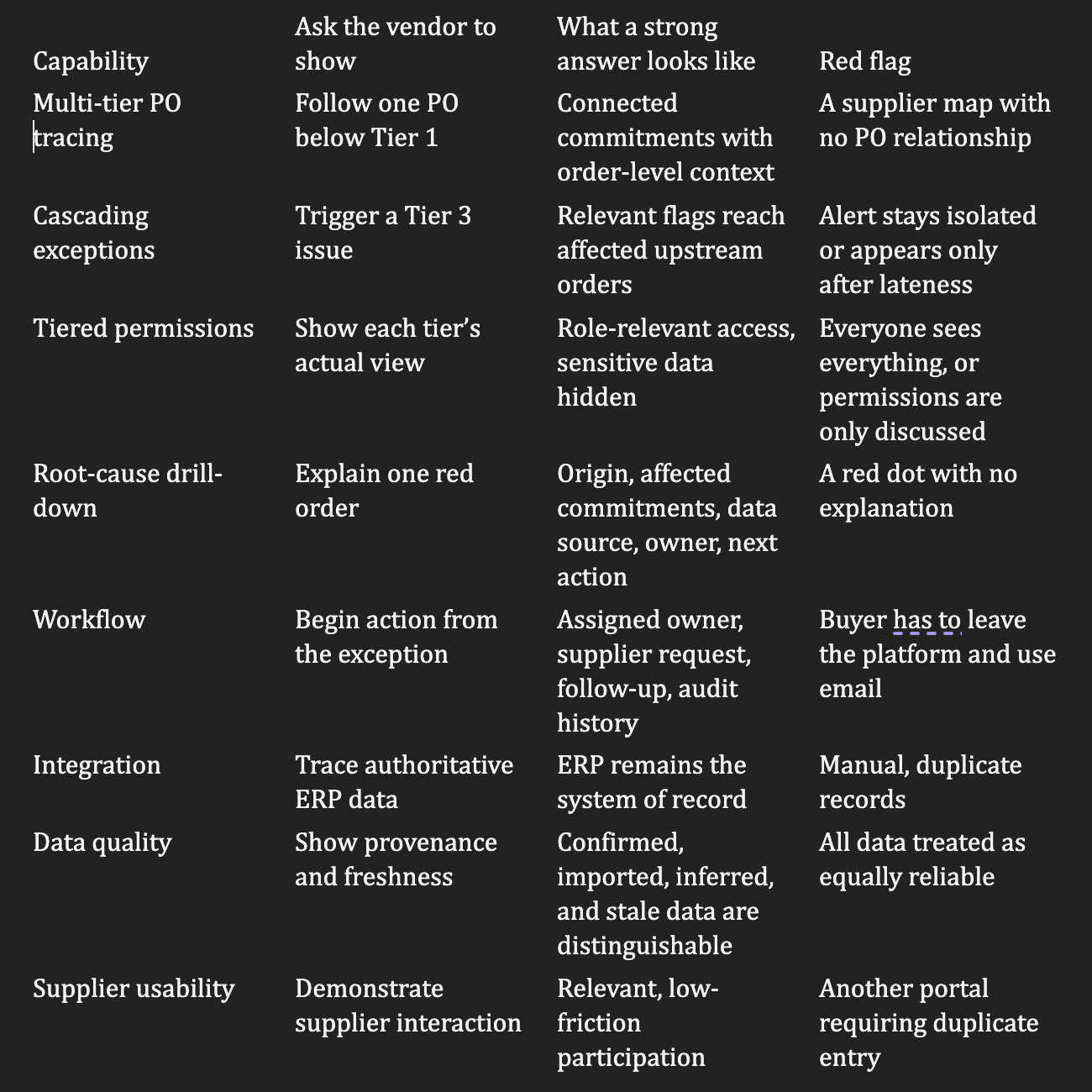
Beyond the four core tests: on workflow, can a user act on an exception directly, assign an owner, and escalate if nothing happens? On integration, does the platform work alongside your ERP without becoming a second system of record? On supplier adoption, how much work does a supplier actually have to do? On data quality, is there a clear owner for resolving conflicts? None of this requires a technical background — just a willingness to push past the polished view and into the mechanics underneath it.
A few patterns are worth treating as disqualifying, or close to it: a supplier map presented as order traceability with no connection to an actual PO; a red status indicator with no explanation of origin or affected commitments; “real time” used without anyone defining the data source or update cadence; permissions that are discussed but never actually demonstrated; supplier participation that requires duplicate data entry into yet another portal; alerts that exist but never connect to an assigned workflow; an ERP replacement quietly repositioned as a “visibility project”; no distinction between verified and inferred data; a roadmap capability presented as though it’s already live; and an ROI case built almost entirely around avoiding a hypothetical catastrophic disruption rather than documented, everyday operating costs.
Your CFO does not approve red dots. Your CFO approves a defensible business case — which means the financial argument for visibility software has to survive the same scrutiny as any other capital request.
Some of the numbers that circulate in this space are more solid than others. McKinsey has documented a case study of one aerospace manufacturer that restructured its capacity model and built a centralized analytics function; the results included an 8–20% increase in shipments, a 30–50% reduction in expedited-service costs, and a 15–20% improvement in inventory turns.
Separately, The Hackett Group’s 2025 Working Capital Survey found roughly $1.7 trillion in excess working capital sitting idle across the 1,000 largest U.S. public companies — a figure that spans receivables, payables, and inventory together, not inventory alone, and isn’t a claim that the entire amount stems from visibility gaps. And Accenture’s “Next stop, next-gen” research, which studied 1,148 companies across 15 countries, found that the top 10% of companies on a broader supply-chain-maturity scale — built around AI, automation, and advanced planning capability, not visibility software specifically — posted 23% higher profit margins than peers between 2019 and 2023.
Use figures like these as external context for setting realistic scenario ranges, not as promised outcomes. The standalone ROI worksheet below walks through the actual formulas: current versus improved inventory turns, potential working capital release, expediting savings, recoverable buyer capacity, and a resulting operating ROI and payback period — split clearly into recurring P&L savings, one-time balance-sheet effects, and any risk-avoidance scenario, so nothing gets double-counted. The strongest business case is not the one with the largest number. It is the one finance can audit.
Run the four tests above against ChainLink SRM the same way you’d run them against anyone else. Here’s where it stands today, plainly stated.
ChainLink SRM is built to operate around your ERP as an execution layer rather than replace it, organizing open order data into dashboards that drill down from a portfolio view into supplier, buyer, program, part, PO line, date, and exception detail. Supplier responses are captured in a structured format and stay linked to the order record instead of living in an inbox. Configurable rules support follow-up and escalation when a supplier goes quiet or an action goes overdue, and buyers work from a prioritized queue of exceptions rather than an undifferentiated list of every open line.
Where ChainLink SRM is genuinely category-leading, and the reason it belongs on this list ahead of the field in all groups above: onboarding and sourcing can require a Tier 1 supplier to document its own upstream vendors and commitments directly inside the same platform that manages the PO — not in a separate risk tool, not as a one-time survey, but as a standing part of how that supplier relationship is managed. The Tier 1 point solutions in this market have no mechanism to capture this at all. That’s the hard, structural part of multi-tier visibility — getting the data to exist in a usable form in the first place — and ChainLink SRM already does it, without requiring the enterprise-scale cost and multi-year implementation of a full source-to-pay suite, and without stopping at a risk score the way a dedicated mapping platform does. ChainLink SRM is the option in that segment that also structurally captures sub-tier data inside the same record as the live PO.
“The 42% Problem" and "What It Takes to Trace an Open PO Three Tiers Deep" laid out why this matters and what it structurally requires. This article is the test you can actually run in a 20-minute conversation with your own data — for ChainLink SRM and for anyone else on your shortlist.
Learn more about ChainLink SRM’s approach to Open Order Management.
David is the Chief Operations Officer and Director of Business Development at TTP Solutions LLC. Since 2019, David has been the driving force behind sales, marketing, and organizational development. David holds a B.B.A. in Entrepreneurship and a B.A. in Spanish from Middle Tennessee State University. He has a passion for helping others to solve problems creatively. Husband to KerrieAnn, David loves photography, hiking, traveling, and reading.